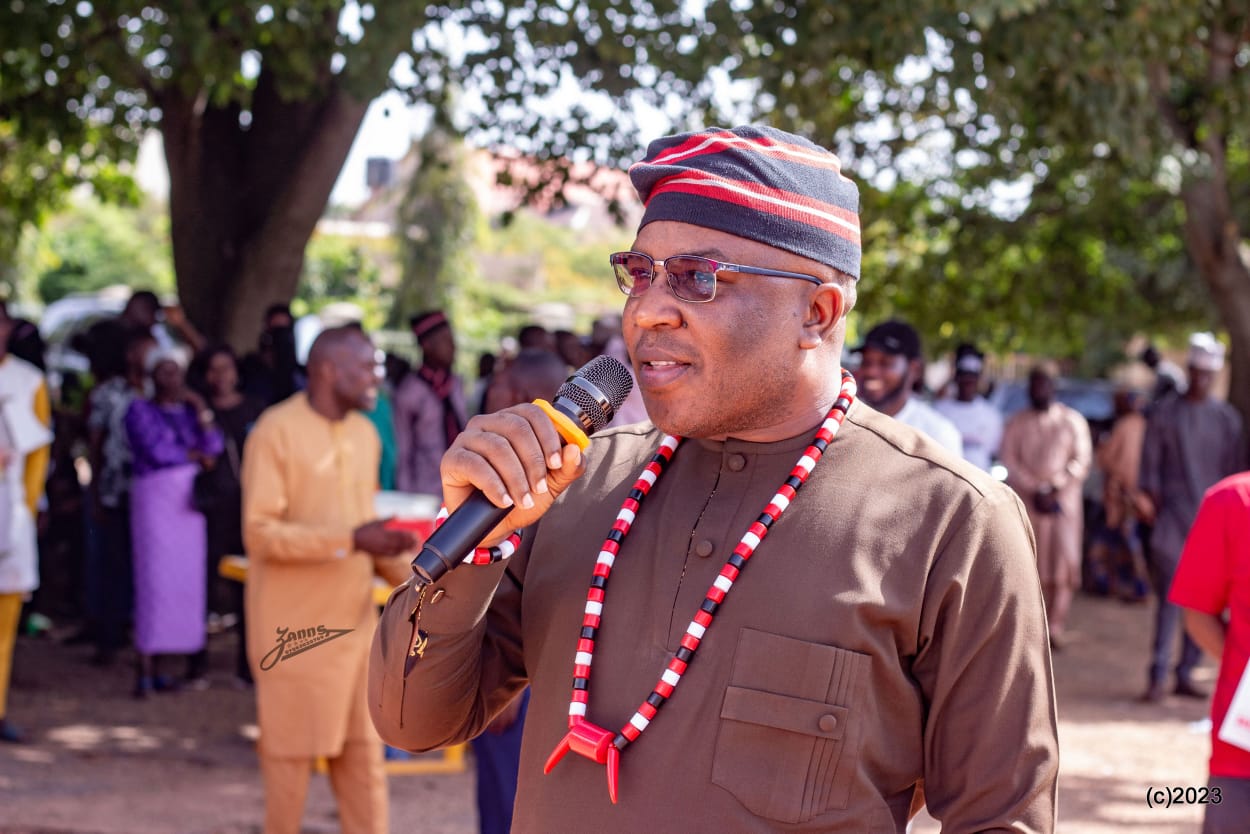
By Gizo Kuulyidamsu, Jos.
I am positively jealous of the administrative and infrastructural leadership traits of the Honorable Commissioner for Local Government and Chieftaincy Affairs, Plateau State, Chief Ephraim Usman, who has virally commenced both administrative and infrastructural revolutionary development of the ministry as well as the local government areas of the State anchored on the governor’s campaign promises which I will largely x-ray in the next episode of this masterpiece.
If you visit the ministry as well as the local government areas at this moment, you will accept the fact that leadership traits of Ephraim Usman are essential qualities that make effective governance at workplace including socio-economic and infrastructural dimensions. His traits in governance is an epitome of success in leadership skills, innovation, unique infrastructural openings, maintenance, workers welfare and motivation, asundry development and disciplinary approach to governance.
I observed that the most important leadership qualities of Chief Ephraim Usman involve uncommon skills and technical knowledge for diligence, infrastructural and industrial specificity to initiating new ideas. There seems to be a sudden breathe of development and confidence in the ministry for local government and chieftaincy affairs and the 17 local government councils today.
From its fundamentals, politics is all about the attainment of power and deploying it to public life and to the benefit of the people remains the mutual evaluation and accomplishment of Chief Ephraim Usman. He has proven to be different from others simply because he’s been tested with leadership positions and had delivered positively on those occasions.
Leadership, it must be understood, is not a mere insignia but a practical measure as demonstrated by Ephraim Usman. He is a leader that makes a difference by listening to others. He listens receptively to what his people are saying and what they don’t say. He is a leader that makes a difference by learning how to use persuasive skills to convince his people to do something instead of bullying.
He is not the authoritarian or narcissistic leader who uses his position to make decisions without considering the concern of his people. I will continue to advise the Honorable Commissioner to continuously rise in unison to taking the proactive administrative ate and infrastructural policies with progressive mindedness, transparency and accountability because leadership position particularly in democracy and irrespective of the level or stage must be appreciated as a privileged call to responsibility and civilised governance which includes democratic accountability and stewardship.
Indeed, from every indication, leadership responsibilities, accountability and stewardship have biblical roots. For instance, in Exodus 38:21-29, Moses accounted for all the money and materials used in the construction of the Tabernacle. He was conscious of the fact that resources were generated by masses (The tax payers).In Genesis 2:15-17, the imperative of responsibility or reliable leadership in management manifested in the Garden of Eden when God called Adam to ascertain the situation in the garden. But typical of human beings, Adam gave excuses for his failure. What about Joseph in Potiphar’s house (Genesis 39:4-6). He displayed diligence, craftsmanship and ingenious statesmanship as essential elements of leadership and integrity.
In my view, Chief Ephraim Usman is creating an uncommon performance in governance and antecedents in the ministry for local government and chieftaincy affairs. I deeply believe he shares same traits with plateau greatestwho are legendarily remembered for their revolutionary ideas and commitment to good governance.

 Nigeria Star News